
Know the Ingredient: Understanding Parabens, Phthalates, and Sulfates

Updated: 5 hours ago
You see the words everywhere:
PARABEN-FREE • PHTHALATE-FREE • SULFATE-FREE
They're printed on shampoo bottles, moisturizers, body washes, cleansers, and natural-care products. But have you ever stopped and wondered:
What exactly are parabens, phthalates, and sulfates? What do they do? And does your skin actually benefit from avoiding them?
At Adjourn4U Wellness, we don't believe natural care should be driven by fear. We believe it should begin with understanding what you're putting on your body.
So let's meet three of the most talked-about ingredient families in personal care.

Parabens - Paraben-Free
Parabens are preservatives. Common examples include methylparaben, propylparaben, butylparaben, and ethylparaben. Their job is important: they help prevent bacteria and mold from growing in cosmetics. U.S. Food and Drug Administration
So why are people avoiding them? Some concern has centered on whether certain parabens can have estrogen-like activity. However, this is where wellness conversations need some balance: the FDA says it does not currently have information showing that parabens as used in cosmetics affect human health, while continuing to evaluate new research. U.S. Food and Drug Administration
That means paraben-free is a consumer formulation preference—not proof that a product is automatically safer.
There's another important catch: a paraben-free lotion, toner, or body wash containing water still needs protection from microbial contamination. At Adjourn4U, paraben-free should never mean preservation-free. It means selecting an appropriate alternative preservation system when a formula requires one.

Phthalates - Phthalate-Free
Phthalates are a family of chemicals with numerous applications. In cosmetics, certain phthalates have historically been associated with uses such as fragrance formulations and nail products.
The FDA reports that its surveys have found diethyl phthalate (DEP) to be the phthalate still commonly used in cosmetics. The FDA also states that it currently does not have evidence that phthalates as used in cosmetics pose a safety risk. U.S. Food and Drug Administration
So why choose phthalate-free? For some consumers, it's about reducing unnecessary exposure where alternatives are available. Others prefer products formulated without them as part of their broader approach to ingredient-conscious living.
That's a choice Adjourn4U can support without turning the conversation into fear.
Sulfates - Sulfate-Free
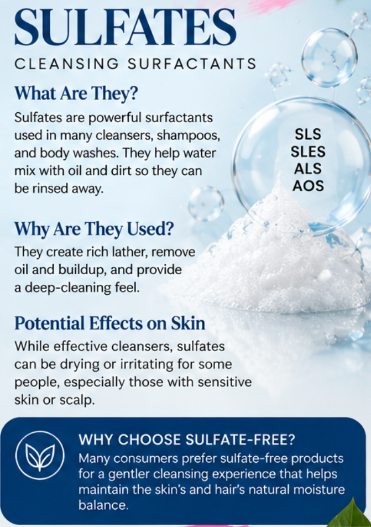
This one is particularly relevant to skin and hair care. Sulfates such as sodium lauryl sulfate (SLS) and sodium laureth sulfate (SLES) are surfactants used in many cleansing products.
Think shampoo. Body wash. Facial cleanser. Surfactants help oil and soil mix with water so they can be rinsed away. And yes—they actually clean.
The problem isn't that cleansing is bad. The question is whether a particular cleansing system is appropriate for your skin or scalp. Some stronger cleansing formulas can leave certain people's skin feeling dry, tight, or irritated. The American Academy of Dermatology recommends mild, fragrance-free cleansers for sensitive skin and, in certain situations, specifically recommends avoiding shampoos containing sodium lauryl sulfate or sodium laureth sulfate because they can be irritating. American Academy of Dermatology
That's an important distinction.
Sulfate-free doesn't mean sulfate-containing products are inherently dangerous. It can mean choosing a gentler cleansing experience when that's what your skin or hair needs.
Should You Go Paraben-Free, Phthalate- & Sulfate-Free?
You don't have to be afraid of your bathroom cabinet. Instead, become a label reader. Consider what you're using, how often you're using it, and—especially—how your skin responds.
If your cleanser consistently leaves your face tight and uncomfortable, pay attention.
If your body wash leaves your skin dry, reconsider your cleansing routine.
If certain fragranced products cause itching or irritation, that's worth noticing too. In fact, dermatologists specifically recommend fragrance-free products for sensitive skin because fragrance can trigger irritation or allergic reactions in some people. American Academy of Dermatology
And remember: natural doesn't automatically mean non-irritating. Essential oils, botanicals, and fragrances can also cause reactions, too.
That's why ingredient awareness matters more than simply following what's printed on the front of a bottle.

The Adjourn4U Approach
This is where our philosophy becomes different. Adjourn4U believes personal care can be intentional without becoming complicated. Our approach centers on thoughtfully formulated products using carefully selected oils, butters, botanicals, clays, extracts, and other ingredients chosen for a purpose—not simply because they're fashionable.
For cleansing, we can choose formulations designed to clean without chasing excessive foam. For moisturizing, we can use nourishing oils and butters appropriate to the formulation. And when a water-based product needs preservation?
We preserve it properly.
Because safe natural care is still science.
The goal isn't to create the shortest ingredient list imaginable.
It's to create a product in which the ingredients make sense.

Your New Rule: Flip the Bottle Over, and READ the Ingredients
The next time you pick up a shampoo, cleanser, lotion, or body wash, don't just look at the pretty front label.
Turn it around.
Look for names such as:
Parabens: methylparaben, propylparaben, butylparaben, ethylparaben.
Sulfates commonly discussed in cleansers: sodium lauryl sulfate (SLS) and sodium laureth sulfate (SLES).
Phthalates can be harder for consumers to identify because cosmetic fragrance mixtures may be listed simply as “fragrance” rather than disclosing every individual fragrance component.
Then ask yourself three questions:
What is this ingredient doing?
Does this product work well for my skin?
Is there an alternative I'd rather use?
That's mindful natural care. Not fear. Not perfection.
Awareness. Choice. Intention.
And sometimes, changing your wellness routine starts with something as simple as turning the bottle and finally reading what's inside.
Adjourn4U — Self-Care is Your Power.
At Adjourn4U, we invite you to explore thoughtfully made alternatives for your everyday skincare, haircare, bath, body, grooming, and wellness routines. Embrace the journey of self-care and discover the power of informed choices.


Comments